India’s space programme is noted for delivering remarkable results while staying far below typical budgets, exemplified by the Mars Orbiter Mission as well as Chandrayaan-3. Launched in 2013, the Mars Orbiter Mission carried an overall price tag of roughly ₹450 crore, ranking it among the cheapest interplanetary flights ever. NASA’s MAVEN mission to Mars was priced at roughly $485 million.
For years, India’s space agency has achieved impressive results while keeping costs remarkably low. But as the nation’s space goals expand, this efficient model is shifting. The push now is to support a private space sector, demanding more resources, infrastructure, and commercial expertise than the government can provide alone.
ISRO’s Changing Role
The upcoming FY27 budget allocates ₹10,397 crore to space technology, covering rockets, spacecraft, and initiatives like Gaganyaan. Meanwhile, funding for developing, launching, and maintaining India’s INSAT satellites has dropped sharply—from ₹345 crore in FY22 to just ₹131 crore in FY27. This shift signals both a reallocation of funds and a change in ISRO’s expected role.
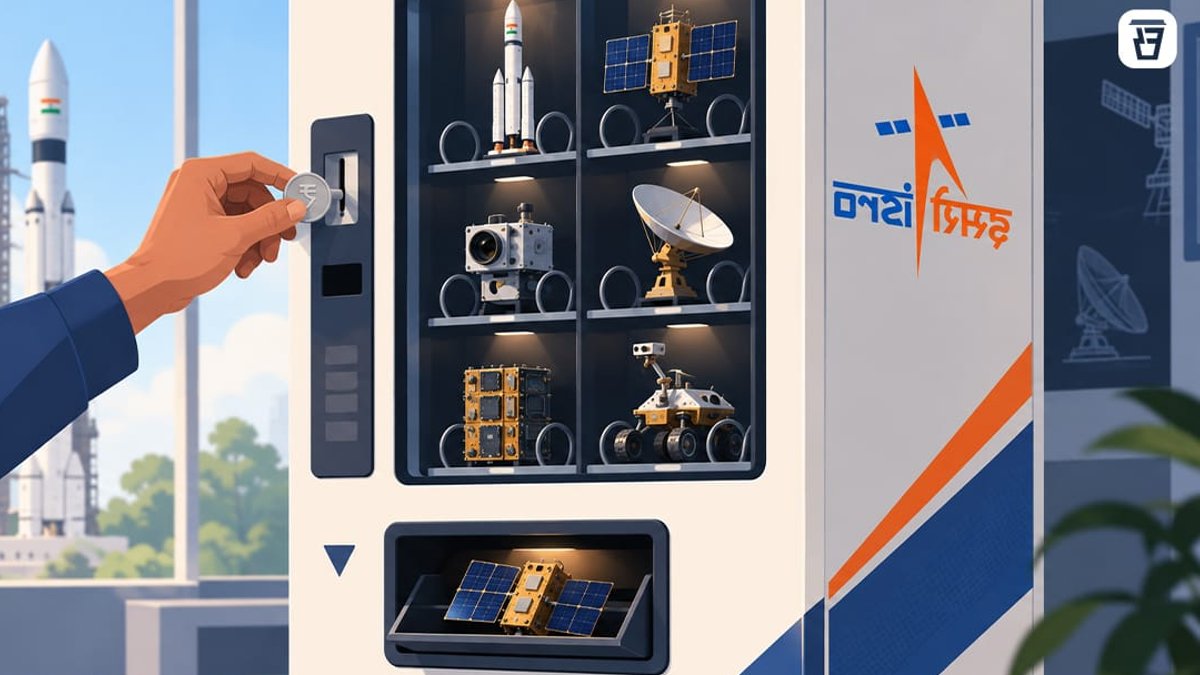
Once these systems are mature, they can be handed over to private companies for commercial use. The government also needs to separate the different roles that were once housed within ISRO.
The 2023 policy divides India’s space sector into four key entities: ISRO, IN-SPACe, NSIL, and the Department of Space. ISRO will concentrate on advanced research, deep-space missions, crewed spaceflight, and next-generation capabilities. IN-SPACe will regulate and support private firms entering areas previously exclusive to ISRO.
Related Post: India rice output to fall sharply
Technology Transfer and Private Industry
NSIL, or NewSpace India Limited, serves as the commercial bridge, marketing mature ISRO technologies and services. It has already partnered with HAL and L&T to manufacture launch vehicles, and SSLV technology has been transferred to HAL. These moves aim to accelerate the growth of India’s commercial space industry.
However, handing over the commercial side of space only makes sense if ISRO can use the freed-up capacity to focus more on R&D. And for that, it needs exceptional scientists and engineers. The irony is that the very private space industry ISRO is helping create could also become a source of competition for that talent. Over 100 ISRO scientists and technical personnel have resigned or sought VRS, including people associated with important programmes such as Gaganyaan.
With more career options available outside ISRO, many scientists are now eyeing private sector roles, often with higher pay. This creates a dilemma: the government is building an industry to adopt ISRO’s technology, yet that same industry may lure away the experts who created it.
By 2026, ISRO, NSIL, and IN-SPACe had signed over 100 technology-transfer agreements with non-government entities. NSIL’s commercial revenue grew from ₹322 crore in 2020 to over ₹3,000 crore in 2025. Roughly 70 of those 100 agreements reportedly involved licensing fees of less than ₹10 lakh each, with some technologies being transferred for ₹6,000.
This approach is different from NASA’s commercial technology licences, which can include an upfront fee, annual minimum royalty, and a running royalty linked to sales. The success of this reform will be determined by what ISRO does with the bandwidth it frees up and the licensing fees it generates, including the ₹570 crore set aside for Space Science in the FY27 budget.





Leave a Reply