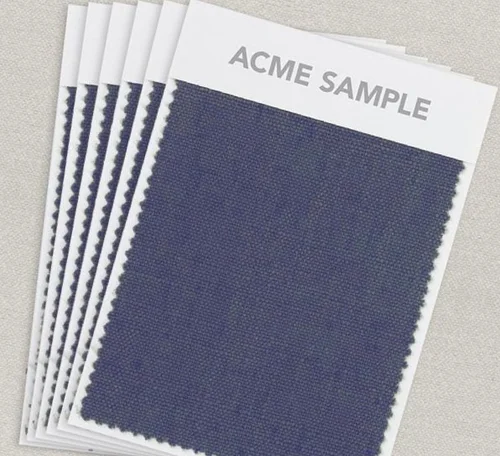
The textile industry has embraced digital tools at nearly every stage of the buying process. Customers can browse collections online, compare colors, request information, and communicate with suppliers without visiting a showroom. While these changes have made textile sourcing more convenient, physical samples continue to provide something that digital platforms cannot fully reproduce: a direct experience with the material.
Combining digital convenience with physical samples can result in a more comprehensive presentation of materials for fabric manufacturers, suppliers, and product brands. Before making significant purchasing decisions, prospective customers can use custom fabric swatch cards and go beyond pictures thanks to physical samples.
Digital Images Have Their Limits
A cloth can be seen from a variety of perspectives in high-quality photography, but not every physical feature can be captured in a picture. It might be challenging to adequately assess texture, softness, thickness, flexibility, weight, and surface quality from a screen.
Color can sometimes be problematic. The way tints appear digitally can be impacted by variations in monitors, device settings, lighting, and photography. When viewed in person, a hue that appears appropriate online could look very different.
Physical sampling is still useful in this situation. In order to determine whether the material is suitable for the intended use, a buyer might handle it, inspect its surface, and compare it to other fabrics.
Physical Samples Support More Confident Comparisons
Comparing a number of comparable options is typically necessary when choosing a fabric. These options can be shown side by side in a digital catalog, but real samples let customers compare them further depending on how they feel and look in various lighting conditions.
When choosing upholstery materials, for instance, an interior designer might have to assess a number of neutral hues while taking into account how each fabric works with flooring, furniture, paint, or natural light. Physical samples make that procedure more feasible.
Customers can use well-organized custom fabric swatch cards to compile a number of relevant resources into a small reference that they can consult while making decisions.
Samples Can Extend the Digital Customer Journey
Digital marketing and physical samples don’t have to compete with one another. They can function as complementary components of the same client experience.
Product codes, collection names, website details, or QR codes that link the tangible content to further online resources can all be found on a sample card. After viewing a fabric sample in person, a consumer can browse more colors, specifications, care instructions, or related products using a digital link.
Customers are provided with both types of information by this method: the ease of online research and the tangible experience of the content.
Better Sampling Can Help Remote Buyers
Businesses can now collaborate with suppliers who are located far away due to digital purchasing. However, when purchasers are unable to visit a showroom, distance might make choosing a cloth more difficult.
One way to lessen such uncertainty is to send structured physical samples. Remote purchasers can obtain materials that they can view at home rather than depending solely on images.
This can be very helpful for business tasks when multiple persons must review the materials. Before deciding on a final choice, the same physical sample can be examined by a designer, purchasing manager, customer, or project team.
Consistent Presentation Strengthens Product Information
Presenting a real sample with precise product information increases its usefulness. Buyers may determine precisely the material they are evaluating with the use of names, product numbers, color references, and collection data.
Maintaining a recognizable brand identity is another benefit of consistent sample presentation for organizations. Customers can more readily traverse a variety of material selections when each collection adheres to a standard format.
Making samples look good is not the only goal. While maintaining the tangible content at the heart of the presentation, its design should make information easy to understand.
Combining Digital Efficiency With Physical Experience
The demand for physical product experiences has not decreased despite the rise of e-commerce and digital catalogs. Rather, it has altered the application of physical samples.
Digital platforms are great for communication, product research, discovery, and keeping up with big catalogs. By enabling clients to assess qualities that cannot be fully conveyed through a screen, physical samples provide an additional layer.
Therefore, connecting both systems might be the most sensible strategy for textile companies. While expertly arranged samples offer the tangible proof required to assess them, digital technologies can assist clients in finding and researching materials.
Conclusion
The modern textile purchasing process does not have to be wholly computerized or fully physical. Every format has a distinct function.
While actual samples offer texture, color reference, and a concrete grasp of the material, online catalogs offer speed and accessibility. Customers can more easily transition from initial interest to in-depth evaluation when these experiences are linked through systematic sampling and helpful product information.
Maintaining a careful physical sample strategy can therefore continue to be a crucial component of how materials are presented, compared, and finally chosen for textile firms operating in an increasingly digital marketplace.






Leave a Reply