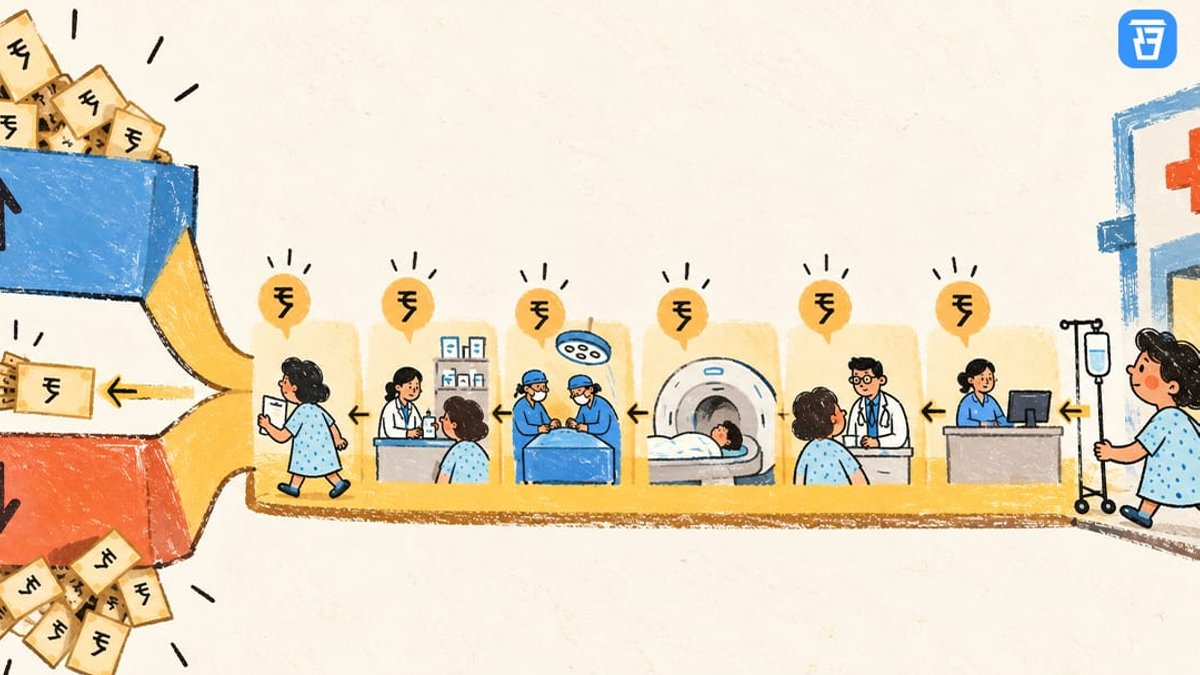
A hospital operates under an atypical model; individuals do not walk in attracted by discounts or brand loyalty, but because they require care. At that instant the facility must supply an appropriate physician, the necessary machinery, and suitable therapy to the patient immediately, even if delivering them is not financially advantageous.
However, a private hospital is still a business, and someone has to pay for the building, beds, MRI machines, nurses, electricity, and everything else that needs to run even when there are no patients around. This creates a tension between the hospital’s public-facing responsibility to provide care and its need to be financially sustainable.
A hospital is not really selling just one thing; a patient’s bill can include treatment, medicines, diagnostics, surgery, consultations, and several other services, each with its own economics. The Supreme Court recently questioned the pricing of medicines sold through private hospitals, with one cancer drug being sold at an MRP of ₹27,000 despite being supplied to retailers for ₹2,700.
Understanding Hospital Finances
The court’s inquiry raises an issue about how the economics of private healthcare actually works. India’s private hospital chains have benefitted from offering sophisticated medical treatment at a fraction of what patients might pay in the US, the UK, or parts of the Middle East, with procedures in India costing around 70% less than in developed markets.
Hospitals as Multiple Business Units
A hospital is not really one business, but a collection of businesses operating under the same roof, from beds and operating theatres to diagnostics, pharmacies, and emergency departments. All of this infrastructure costs money whether or not it is being used, meaning a hospital may have 500 beds but cannot generate revenue from all of them every day.
The key to a hospital’s profitability lies in how effectively it converts its infrastructure into revenue. Take something as basic as a hospital bed; it generates no revenue when it is empty, which is why occupancy matters so much. ICRA’s sample of 11 listed hospital companies averaged 63% occupancy in FY26, despite which the companies earned an operating profit margin of 24%.
Measuring Profitability: ARPOB and Occupancy
Metrics such as average revenue per occupied bed (ARPOB) become useful in understanding hospital finances. Fortis, for instance, reported an ARPOB of around ₹68,700 per occupied bed per day in FY26, with an occupancy of 68%. The company’s six focus specialities, including cardiac sciences, oncology, neurosciences, gastroenterology, orthopaedics, and renal sciences, accounted for about 62% of hospital revenue.
Occupancy and Revenue
The reason for this focus on specialities seems straightforward: a patient coming in for a complex cardiac procedure or cancer treatment may require expensive diagnostics, surgery, medicines, and several consultations. But a routine admission may require far fewer of these services. So hospitals care not just about how many beds are occupied, but also about what happens to the patients occupying them.
This helps explain why the industry has been moving towards high-acuity specialities. Manipal, for example, reported that cardiac sciences, oncology, neurosciences, gastro sciences, orthopaedics, and renal sciences accounted for 64% of gross inpatient revenue in the first half of FY26. Another piece of the puzzle is how long patients stay, which is why hospitals pay close attention to average length of stay (ALOS).
Apollo, for example, reported an inpatient ALOS of 3.14 days in Q1 FY26, down from 3.34 days a year earlier, while inpatient volumes rose by 3.2%. Average revenue per inpatient rose by 8.9% to ₹1.72 lakh. The point is that shorter stays do not automatically mean better economics since clinical requirements come first. But when technology and treatment protocols allow patients to recover safely in less time, the same infrastructure can support more admissions.
How Payer Mix Shapes Revenues
The economics can also depend on who is paying for the treatment. A hospital may treat self-paying, insured, corporate, or government-scheme patients, and the amount it realises can differ significantly across these categories. Max Healthcare, for example, has said that its institutional business has historically generated an ARPOB of around 40% lower than other channels.
Max estimated that replacing some institutional beds with higher-yielding channels could improve EBITDA margins by around 3-4%. This is also why opening a new hospital is not as straightforward as adding another revenue-generating asset. Because a new hospital starts with the costs of a mature facility but only a fraction of the patients, it can take years to build its doctor network, referral base, and patient volumes.
Growth Strategies: Brownfield vs New Builds
Hospital companies have increasingly looked at brownfield expansion, acquisitions, and asset-light operating models alongside completely new hospitals. That’s because adding beds to an existing campus can be faster, as the hospital already has doctors, patients, referrals, and supporting infrastructure. So it helps chains expand with less capital, while new hospitals can put pressure on margins until occupancy matures.
Hospital chains are also expanding beyond the core business itself. Some listed healthcare companies are no longer just hospital operators; Apollo, for instance, simultaneously operates pharmacies and digital health. In H1 FY26, its offline pharmacy distribution business generated ₹4,498 crore of revenue at a 7.7% operating EBITDA margin before costs, while the digital business had a different cost structure.
Fortis has a similar example through diagnostics, with its diagnostics business generating ₹1,527 crore of revenue in FY26 at a 23.6% EBITDA margin. The Supreme Court’s question about medicine prices brings us back to the core financial reality of private healthcare. Drug mark-ups may provide a useful revenue cushion, but they are not a sustainable substitute for a good hospital business.
A hospital becomes structurally profitable by keeping its beds occupied, moving patients through them efficiently, attracting higher-acuity cases, managing its payer mix, and controlling the cost of delivering treatment.





Leave a Reply