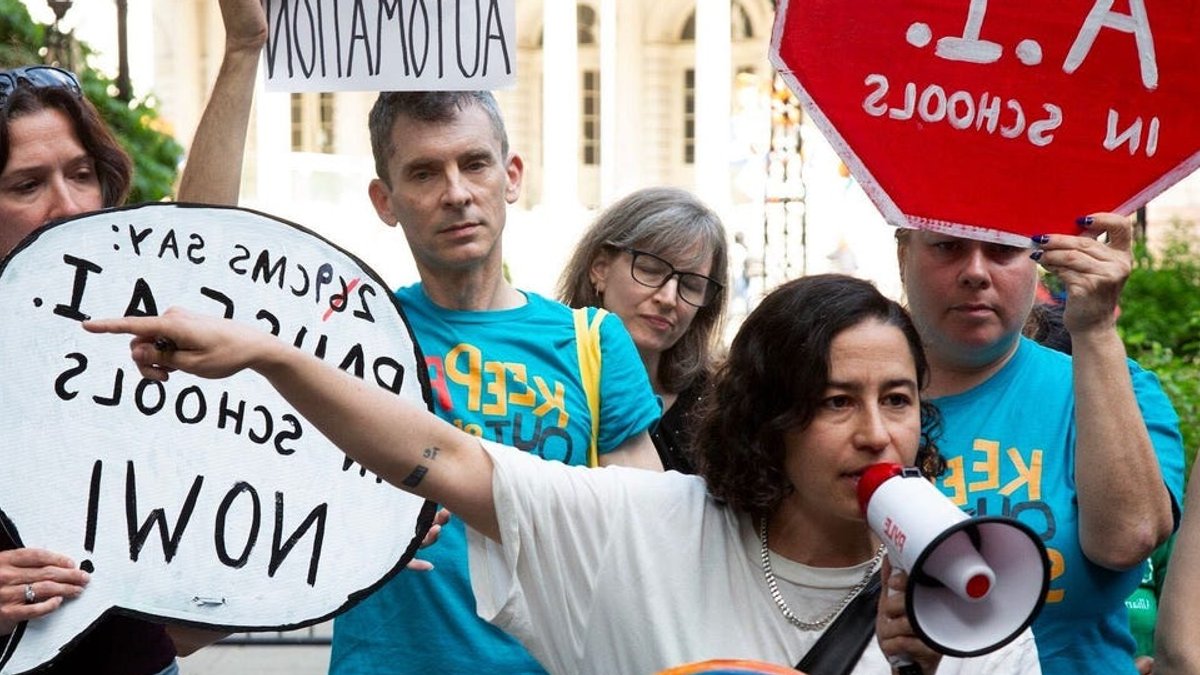
New York City Mayor Zohran Mamdani has announced a one-year moratorium on student-facing AI platforms in the city’s public schools for elementary and middle school students. The decision came after months of lobbying from two opposing groups of parents who pushed the administration to pause the technology. The measure, which takes effect immediately, will turn off the AI features in programs like Amira, which was used in one Brooklyn district to help 5-year-olds practice reading.
Craig Garrett, a book editor in Brooklyn, said he was shocked to learn his daughter was talking to an animated AI character every day at school. He attended a meeting last May where educators revealed the extent of AI use in her classroom. The revelation “radicalized” many parents in the room, leading Garrett to join the AIM coalition, a group dedicated to halting AI use in schools. The coalition had two meetings with NYCPS Chancellor Kevin Samuels in recent months.
Those concerned parents aren’t the only ones weighing in. A different cohort believes students need to be taught how to use AI to remain competitive in the workforce. Keri Rodrigues, the founding president of the National Parents Union, said references to AI skills in job postings in the United States have more than doubled in the last six months. Rodrigues supports AI use in schools but argues the city’s approach is too aggressive.
Related: Jet Li: Ditching ‘General’ Role for Fatherhood
City officials said they engaged with various stakeholders, including educators, students, parents, and union partners, to shape the policy. The new guidelines allow teachers to use generative AI for lesson planning, but they cannot use it to grade assignments. High school students will take “AI literacy” courses and have access to five pilot AI programs, none of which are chatbots.
Debate over readiness and regulation
The moratorium falls short of the two-year pause the AIM coalition demanded. Some parents in that group expressed relief, while others felt blindsided by how much data their children were sharing. Liat Olenick, a leader of the group, said the movement took off because it struck a nerve. “All of a sudden, one day, people were like, ‘Wait, my 7-year-old’s using AI? I never gave permission for that,'” she said.
The CEO of Amira, Mark Angel, defended the software’s role as a tool for teachers to diagnose reading challenges. Rodrigues described the ban as a “hysterical response” that could leave students unprepared for a job market that values AI skills. She said the policy uses a sledgehammer instead of a scalpel, ignoring the nuance required for effective implementation.
Related: Trump sparks meme frenzy with Lake America rename
Kaliris Salas-Ramirez, a neuroscientist and associate professor at Rutgers University, said research suggests young children using AI tools risk preventing their brains from developing problem-solving skills. “We’re actually not allowing the brain to consolidate that information in a full way,” she said.
Garrett, whose daughter is now entering second grade, said he is relieved the Amira app won’t be used as often. “It’s not like this app was doing something that teachers couldn’t do before,” he said.




Leave a Reply