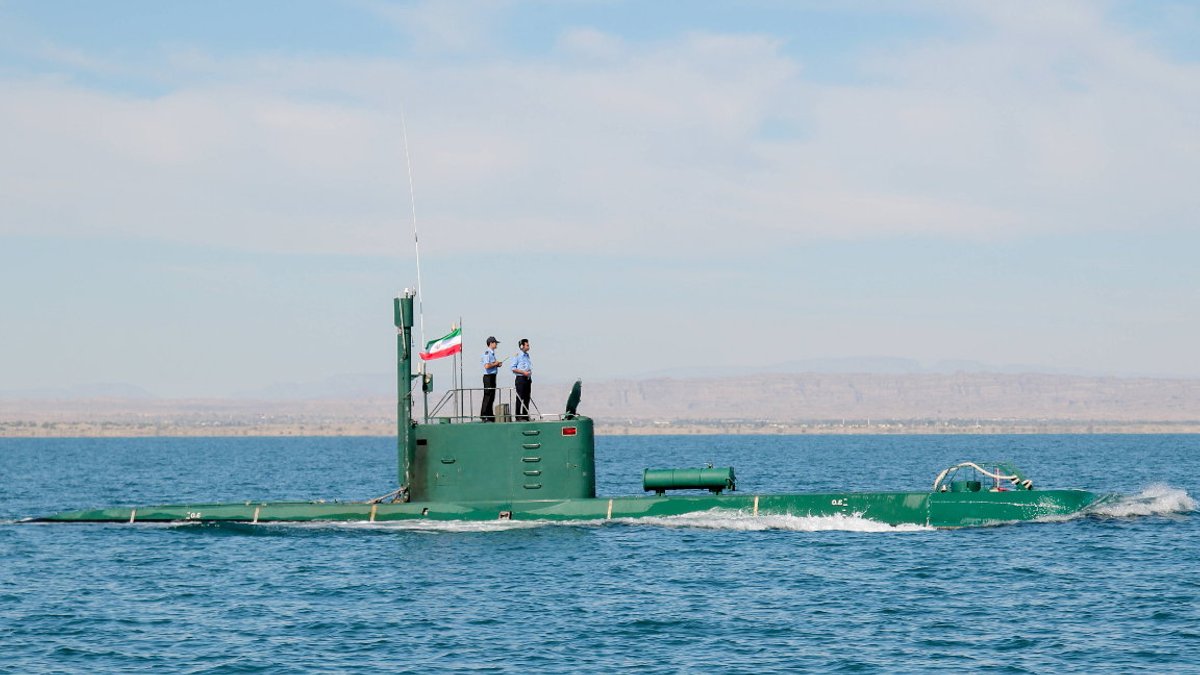
Iran possessed a significant fleet of Ghadir-class mini-submarines before the war began, though estimates of their current size vary widely.
Developed with technical assistance from North Korea, the Ghadir-class submarines were specifically designed for asymmetric warfare in the shallow waters of the Persian Gulf. These vessels measure approximately 29 meters in length and have a submerged displacement of 125 tons. They are operated by a crew of seven and are armed with two forward-firing 533 mm torpedo tubes.
Unlike the larger Russian-built Kilo-class submarines, the Ghadir class lacks sophisticated sensors, high speed, and long-range endurance. Their primary tactical advantage lies in their small size, which allows them to operate near the sea floor in shallow waters. This enables them to hide and deploy special forces, lay naval mines, or conduct surprise attacks against commercial shipping lanes.
Related: US Develops Hypersonic Cruise Missile
The program traces its origins to the early 2000s, when North Korea reportedly provided a Yono-class submarine. Iranian engineers at Shahid Darvishi Industries, a subsidiary of the Defense Ministry, adapted this technology for local production. The first domestically built Ghadir entered service in 2007. The danger posed by this class was highlighted in 2010 when a North Korean torpedo, likely launched from a Yono-class vessel, sank the South Korean corvette Cheonan.
Discrepancies in Fleet Numbers
Discrepancies regarding the size and current status of the fleet remain a subject of debate among intelligence agencies. In March 2026, U.S. Defense Secretary Pete Hegseth stated that the entire Iranian submarine force—estimated at 11 vessels—had been completely eliminated by American strikes. However, prior evaluations from the Nuclear Threat Initiative suggested a much larger fleet, numbering between 23 and 30 submarines.
Furthermore, the International Institute for Strategic Studies identified at least 16 Ghadirs, and Iran asserted that submarines were deployed in the Strait of Hormuz well after the U.S. declared the fleet destroyed.
Related: African football makes global comeback
Proof of American strikes against these assets exists but is incomplete. In July, CENTCOM released a video showing attack drones destroying a maintenance center in Bandar Abbas, where a Ghadir was spotted on a pier. The fact that a submarine was targeted months after the Pentagon announced the fleet’s disappearance suggests either an initial count was inaccurate or that reserve hulls and damaged vessels remained in service.
Although the United States has not provided a detailed, hull-by-hull list of destroyed submarines, it is evident that naval infrastructure and command capabilities have been significantly weakened.
Even if only a few of these small submarines remain undetected, they force adversarial navies to dedicate substantial resources to search and surveillance operations to ensure the safety of commercial maritime transport. The loss of specialized land-based support, operational workshops, and trained crews required for submarine combat would likely negate the value of any surviving hulls.





Leave a Reply