
“`html
Introduction: Why Business Literacy is Your Greatest Asset
In the modern economy, information is the most valuable currency. However, the sheer volume of business news—ranging from stock market fluctuations and Federal Reserve announcements to tech disruptions and global trade wars—can be overwhelming. Many professionals want to “understand the markets,” but they find themselves lost in a sea of jargon and conflicting data.
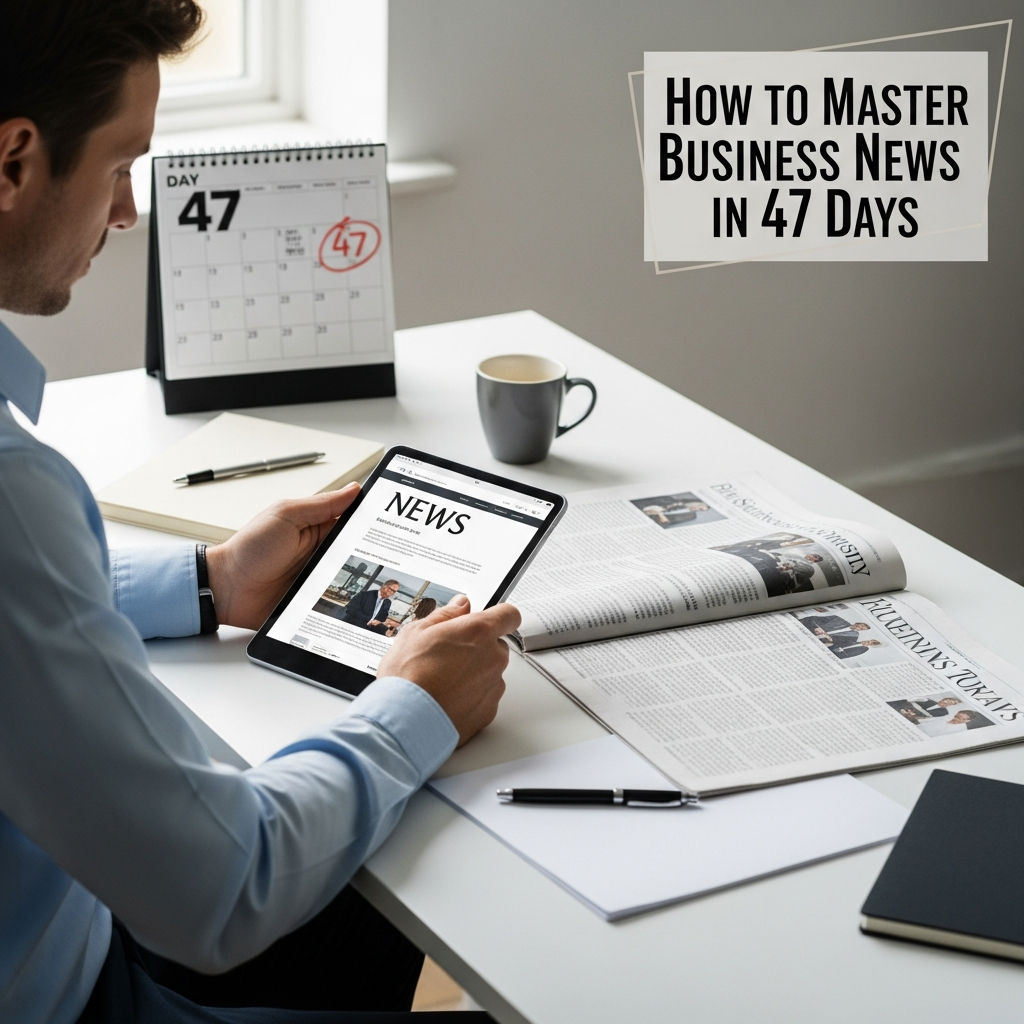
Mastering business news isn’t about memorizing stock tickers; it’s about developing a framework to understand how the world works. Why 47 days? Because it takes 21 days to form a habit and another 26 to solidify that habit into a cognitive skill. By following this structured roadmap, you will move from a confused observer to a confident analyst of the global economy.
Phase 1: Building the Foundation (Days 1–10)
The first ten days are dedicated to “learning the language.” You cannot interpret the news if you don’t understand the vocabulary used by journalists and analysts.
Identify Your Core Sources
Not all news is created equal. To master business news, you must curate a high-quality feed. Start with these three pillars:
- The Wall Street Journal (WSJ): The gold standard for corporate news and domestic economic policy.
- Financial Times (FT): Essential for understanding global trade, European markets, and international relations.
- Bloomberg: The leader in real-time data and market-moving breaking news.
Master the “Big Four” Vocabulary
During these first ten days, focus on understanding four key concepts that drive 90% of business headlines:
- Monetary Policy: What is the Federal Reserve? Why do interest rates matter?
- Fiscal Policy: How do government spending and taxation affect the private sector?
- Market Cycles: Understanding the difference between a Bull market (rising) and a Bear market (falling).
- Macro Indicators: Learning to read GDP growth, CPI (Inflation), and Unemployment rates.
Phase 2: Decoding Corporate Performance (Days 11–25)
Once you understand the broader economy, it’s time to look at the individual players: corporations. This phase focuses on how companies report their success and failure.
The Earnings Season Deep Dive
Public companies are required to release their financial results every quarter. This is when the “noise” of business news becomes “signal.” Pay attention to:
- Revenue vs. Profit: A company can have billions in sales but still lose money.
- EPS (Earnings Per Share): The primary metric Wall Street uses to value a company’s performance.
- Guidance: This is often more important than the actual numbers. What does the CEO expect to happen in the next six months?
Understanding the Three Financial Statements
Spend days 15–20 learning to skim the 10-K (annual report) and 10-Q (quarterly report). You don’t need to be an accountant, but you should know what to look for in the Income Statement, the Balance Sheet, and the Cash Flow Statement.
Industry-Specific Nuance
Business news changes depending on the sector. A “good” headline for a tech company (high growth, high burn) looks very different from a “good” headline for a utility company (stable dividends, low growth). Pick three sectors—such as Tech, Energy, and Consumer Staples—and study their specific metrics.
Phase 3: Connecting the Dots (Days 26–40)
Mastery occurs when you can see a news event in one part of the world and predict its impact elsewhere. This is known as “systems thinking.”
The Domino Effect of Global Events
During this phase, stop reading news in isolation. When you read a headline, ask yourself: “If this is true, what else must be true?” For example:
- Scenario: Oil prices spike due to geopolitical tension.
- Impact 1: Airline stocks may drop (higher fuel costs).
- Impact 2: Consumer spending might decrease (less disposable income).
- Impact 3: Inflation may rise, prompting the Fed to hike interest rates.
The Role of Sentiment and Psychology
Markets are driven by humans, and humans are driven by fear and greed. Mastery involves recognizing when news is being driven by “hype” rather than fundamentals. Study the Fear & Greed Index and look for historical parallels, such as the 2000 Dot-com bubble or the 2008 housing crisis, to put current events in perspective.
Curating an Alternative News Feed
Broaden your horizons by following independent analysts, “FinTwit” (Financial Twitter) experts, and podcasts like The Daily Check-Up or Pivot. These sources often provide the “why” behind the “what” reported by major outlets.
Phase 4: Synthesis and Application (Days 41–47)
In the final week, you move from passive consumption to active synthesis. This is where your 47 days of discipline pay off.
Write Your Own Summaries
Every morning for the final seven days, read the top three business stories of the day. Then, write a two-sentence summary for each:
- Sentence 1: What happened?
- Sentence 2: Why does it matter to the average investor or business owner?
This exercise forces your brain to filter out the “fluff” and retain the “meat” of the story.
The Weekly Review Habit
On Day 47, look back at the week’s news. Can you identify the overarching theme? Was it a week defined by “Recession Fears,” “AI Optimism,” or “Political Uncertainty”? Being able to categorize a week’s worth of data into a single narrative is the hallmark of a business news master.
Building Your Sustainable Routine
By now, you have the skills. To maintain them, you need a routine that takes no more than 20 minutes a day:
- Morning (5 mins): Skim the headlines of a major daily (WSJ or FT).
- Mid-day (5 mins): Check a market dashboard (CNBC or Yahoo Finance) to see the “vibe” of the trading day.
- Evening (10 mins): Read one “long-form” analysis piece or listen to a business podcast during your commute.
Conclusion: The Path to Market Fluency
Mastering business news in 47 days isn’t about becoming a walking encyclopedia of financial data. It is about building a mental filter that allows you to ignore 95% of the noise and focus on the 5% that actually moves the needle.
Whether you are an entrepreneur looking to navigate economic shifts, an investor seeking to protect your portfolio, or a professional aiming for a seat at the executive table, business literacy is your competitive advantage. The world’s economy is a giant, interconnected story. Now, you finally have the tools to read it.
“`